

Loyalty scheme enrolment has never been higher. Today, 63% of European adults belong to at least one loyalty programme and in mature markets such as the UK that figure is even higher – 85% as of 2026 (YouGov).
Membership is rising because loyalty schemes are now both expected and needed. Consumers increasingly see them as a standard part of the brand experience, especially as member pricing, rewards and personalised offers become more visible. Economic pressure is also accelerating this behaviour: with household budgets under strain, people are searching harder for value, using promotions more deliberately and prioritising brands that make savings easy to access.
The challenge for loyalty marketers is no longer simply getting customers in the door. It is turning initial sign-up interest into deeper, longer-lasting relationships. This was one of the central challenges explored in Understanding Loyalty in Europe 4.0, Mando and YouGov’s latest annual white paper covering loyalty programme membership, appeal and impact across 24 European markets. While membership and appeal remain strong, the data showed that high participation does not always translate into strong emotional attachment or long-term engagement.
For loyalty leaders, CMOs and programme owners, the implication is clear: the next phase of growth will not come from signing up more members alone. It will come from retaining existing users and designing programmes that resonate, activate and drive repeat engagement. In our loyalty white paper, we explored two tried-and-tested ways to help support this shift: gamification and partnerships. Used well, these approaches to gamification and partnerships in loyalty can turn a passive programme experience into something more active, useful and emotionally engaging; giving members more reasons to return, interact and choose the brand again.
How Gamification Drives Loyalty Programme Engagement
Discounts and points still matter, but they rarely create distinction or emotional pull on their own. Gamification can bridge the gap between functional value and active engagement by turning simple customer actions into repeatable, habit-forming loops through mechanics such as missions, badge collection and chance-based games.
To work, however, gamification must feel purposeful rather than gimmicky. The best mechanics are simple to understand, easy to join and clearly linked to the behaviours the brand wants to encourage.
Three principles matter most:
- Make participation easy: Use low-friction mechanics such as daily games, post-purchase reveals, progress bars or streaks to build habit without adding complexity.
- Connect mechanics to the brand: Ensure the mechanic reinforces what the brand stands for, whether that is value, wellbeing, sustainability, discovery or expertise.
- Reward progress, not just spend: Encourage non-transactional behaviours such as app engagement, content interaction, preference sharing or community participation.
The goal is not to turn every loyalty programme into a game. It is to make loyalty feel more active, achievable and rewarding between purchases.
Zsuzsa Kecsmar, Co-founder and Chief Strategy Officer at Antavo AI Loyalty Cloud, makes the case that “Gamification’s value lies in creating habit, ongoing engagement and incremental behavioural changes,” adding that “Points for purchases alone is easy to copy.”
Example in Practice: Octopus Energy’s Octoplus Scratch Card
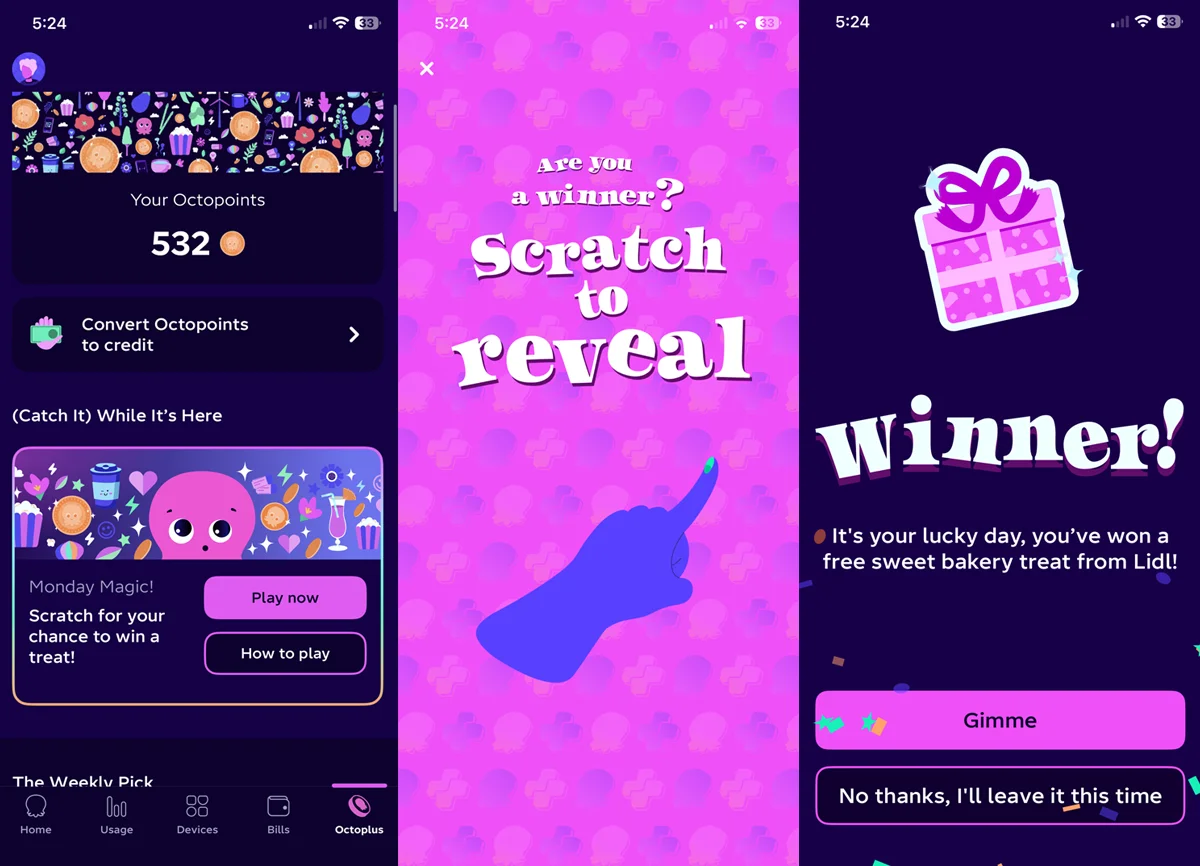
Octopus Energy’s Octoplus Scratch Card is a strong example of low-friction gamification that gives customers a simple reason to return to the app every week. Rather than relying on first-come, first-served reward drops, Octoplus members can open the Octopus app every Monday, go to the Octoplus tab and scratch a digital card for the chance to win instant rewards.
Prizes include everyday treats such as free coffees, sausage rolls and chocolate bars, alongside larger rewards and second-chance prize draws. The mechanic works because it is easy to understand, repeatable and tied to a clear weekly habit. It also helps Octopus turn its rewards programme into a more active experience: members are not just passively collecting value, they are prompted to engage, check in and participate.
Brand Partnerships: Expanding Loyalty Programme Value
Brand partnerships give members more reasons to use a programme by expanding where loyalty shows up in everyday life. Instead of relying only on points, discounts or rewards from the core brand, partnerships can connect a programme to the moments customers already care about: grocery shopping, travel, entertainment, wellbeing, family time, household admin or everyday treats. This is particularly important in categories where buying cycles are less frequent and there are fewer occasions for your brand to remain front of mind.
This matters because activation depends on relevance. Members are more likely to engage when a programme gives them value in more places, across more occasions and at moments when they are not actively shopping with the brand. The right partner can make your loyalty offering feel more useful, more visible and more worth returning to.
Partnerships can also help programmes stretch further. Retention rewards, partner prizes, coalition models, CSR collaborations, sponsorship assets and innovation partnerships all offer different ways to give members something new to notice, redeem, share or participate in. Used well, they turn loyalty from a closed brand mechanic into a broader value ecosystem that fits more naturally into customers’ routines.
Klaus Herzig, Head of Award Programme Development at Miles & More: “In the future, loyalty programmes will thrive not on isolated rewards, but on dynamic partnerships that create seamless, everyday value across brands and experiences.”
Example in Practice: Miles & More x Marriott Bonvoy
Miles & More’s partnership with Marriott Bonvoy shows how loyalty programmes can use partnerships to create value across a fuller customer journey. By allowing members to earn Points through eligible Marriott Bonvoy hotel stays, the partnership connects two naturally linked travel moments: flying and accommodation.
This makes the programme feel more useful beyond the flight itself and gives members more ways to build value within a broader travel ecosystem. It is a strong example of partnership-led loyalty because it adds relevance, increases earning opportunities and strengthens the sense that the programme can support members across their whole trip, not just at a single transaction point.

From Loyalty Programme Membership to Active Engagement
High membership is an excellent starting point, but it is not the same as true brand loyalty. The real opportunity is to turn enrolled members into active members: people who understand the value, engage regularly and let the programme influence what they do next.
Gamification and partnerships in loyalty are two tactics that can help solve this activation challenge in different but complementary ways. Gamification creates momentum and habitual engagement. Partnerships expand the value proposition, making the programme useful in more moments and giving members stronger reasons to redeem, participate or re-engage.
The challenge for loyalty marketers is choosing the right combination of tactics: mechanics that feel natural to the brand, partners that are genuinely relevant to the customer, and rewards that create a clear reason to act. When those elements work together, loyalty becomes less passive and more about repeated, meaningful engagement.
The best programmes will not simply add games for the sake of engagement or partners for the sake of scale. They will start with the customer behaviour they want to encourage, then design experiences that are easy to understand, valuable to take part in and clearly connected to the brand promise.
How Mando Can Help
At Mando, we help brands design loyalty, partnerships, promotions and rewards solutions that are built around real customer behaviour, commercial impact and brilliant brand collaboration. Whether you need to strengthen an existing loyalty programme, develop a more engaging reward strategy, identify the right brand partners or build gamified mechanics that drive repeat participation, we can help you turn loyalty insight into action.
If you’d like to explore how gamification, partnerships or smarter reward design could help activate your loyalty programme…
Get in touch with Mando and we’d be happy to talk.